Liga Voli Mahasiswa 2026: 24 Campuses, Three Cities, and the Question Hidden in the Schedule's Gaps
**মূল উত্তর:** Leagueা ভলি মাহাসিসওয়া (LVM) ২০২৬ হলো MOJI আয়োজিত ইন্দোনেশিয়ার প্রথম বিশ্ববিদ্যালয় Volleyball আসর — ২৪ ক্যাম্পাসের ৩৬ দল, তিন শহরে ৬০ ম্যাচ, জাভাকেন্দ্রিক এবং প্রায় ৫ কোটি রুপিয়াহ প্রাইজমানির একটি ডেভেলপমেন্ট-ও-সম্প্রচার উদ্যোগ। **মূল তথ্য:** - আয়োজক MOJI, স্ট্রিমিং পার্টনার VIDIO; ড্র অনুষ্ঠিত ২৫ সেপ্টেম্বর ২০২৬, আসর ৭–৩১ অক্টোবর ২০২৬। - ২৪ বিশ্ববিদ্যালয়ের ৩৬ দল (১৮ পুরুষ, ১৮ মহিলা), ৬০ ম্যাচ, ১৫ প্রতিযোগিতা দিবস। - ভেন্যু: GOR UII (যোগকার্তা), GOR Unesa (সুরাবায়া), GOR Pertamina Simprug (জাকার্তা)। - প্রতি সেক্টরে প্রাইজমানি ১০/৭.৫/৫/২.৫ মিলিয়ন রুপিয়াহ; দুই সেক্টরে মোট আনুমানিক ৫ কোটি রুপিয়াহ। - PBVSI-র সঙ্গে কোনো স্বীকৃতি বা অগ্রগতির নিয়ম প্রকাশ করা হয়নি। **সূত্র:** Bola.net-এর প্রতিবেদন, MOJI-র ইভেন্ট বিজ্ঞপ্তি অবলম্বনে (প্রকাশ: সেপ্টেম্বর ২০২৬) | Cross-checked: cricsultan.com **সম্ভাব্য Next প্রশ্ন:** প্রশ্ন: LVM ২০২৬-এ মোট কতটি দল খেলছে? উত্তর: ২৪টি বিশ্ববিদ্যালয় থেকে ৩৬টি দল — পুরুষ ও মহিলা সেক্টরে ১৮–১৮ ভাগে। প্রশ্ন: এই আসরে Statisticsভিত্তিক পারফরম্যান্স ডেটা আছে কি? উত্তর: না, ঘোষণায় কোনো সার্ভিস, ব্লক বা রিসেপশন Statistics নেই; মূল তথ্য কেবল লজিস্টিক। প্রশ্ন: LVM কি ইন্দোনেশিয়ার জাতীয় দল বাছাইয়ের পথ? উত্তর: প্রকাশিত তথ্যে PBVSI স্বীকৃতির উল্লেখ নেই, তাই আপাতত এটি ক্যাম্পাস-স্তরের ডেভেলপমেন্ট ও এক্সপোজার আসর।
Nobody asked for the chart. The habit doesn't break: a rally is only chaos until someone numbers it. Last week I laid out the match schedule for Indonesia's Liga Voli Mahasiswa 2026, and the first thing to catch my eye was not a team and not a star — it was a hole. The Yogyakarta leg ends on 11 October, Surabaya begins on 14 October, Jakarta begins on 27 October. Between Surabaya and Jakarta there are eleven consecutive days with no volleyball at all. Smaller, and more telling: Yogyakarta and Surabaya run four slots a day — 13:00, 15:00, 17:00, 19:00 WIB. Jakarta runs the same four slots two hours earlier — 11:00, 13:00, 15:00, 17:00. The venue changed, the rules did not; only the clock moved. In an event that never explains its own schedule, that shift of the clock is the only candid statement it makes.
The organiser is MOJI, an Indonesian sports media platform, and the streaming partner is VIDIO, one of the country's largest OTT channels. The organiser is a media company, not a federation — that single sentence tells you what the event is. Thirty-six teams from twenty-four universities, split 18–18 between men and women, sixty matches across fifteen competition days. The draw was conducted on 25 September 2026. Three venues: GOR UII in Yogyakarta, GOR Unesa in Surabaya and GOR Pertamina Simprug in Jakarta. Prize money per sector runs 10 million rupiah for the champion, 7.5 million for the runner-up, 5 million for third, 2.5 million for fourth — roughly 50 million rupiah in total across both sectors, an estimated three thousand US dollars. Banardi Rachmad, MOJI's Deputy Director of Programming, frames it as making the campus a new stage for volleyball and a showcase for young talent at national level. The report ran on Bola.net, drawn essentially from MOJI's own event release — the numbers are self-reported by the organiser and unverified by any independent technical body. Everything in this piece rests on that announcement; there is no performance statistics anywhere in it, because no ball has been served yet.
Job one: work out what the format actually is. Two pools per gender, three teams per pool — which means two pool matches per team. At 45 to 60 minutes a match, a team's entire group stage is ninety minutes to two hours of volleyball. Then presumably cross-semifinals and a final, although the advancement rules, the tiebreakers and the semifinal structure are nowhere stated. Yogyakarta, Surabaya, Jakarta — each leg reads as self-contained: six men's and six women's teams, twenty matches, its own venue, its own slots. Whether the three leg winners ever meet is a question the announcement does not answer. On everything published so far, this is not a national championship — it is three regional festivals standing under one brand. The difference is not only semantic. A national championship builds one corner, one story, one calendar memory. Three satellite events build three separate stories, and not one of them settles in the viewer's mind.
Job two: measure the sample. Two pool matches per team. In a sample that thin, an event's fate is decided by three things — how long service-reception holds inside a single set, what happens when a bad rotation lands at 22-22, and what the tiebreaker rule says. The first two belong to the coach, the third to the rule-maker. The spread in quality between Indonesian university teams is probably wide — that is not a fact from this announcement but a general expectation at this tier, so I will not use it as evidence. What I will use is the structure: two pool matches, then single-elimination knockout. Where a team gets only two pool matches, the tiebreaker rule is the coach's toughest opponent. Nobody has printed the rule. That is the biggest journalistic gap in this event, because it is exactly where a future dispute will start.
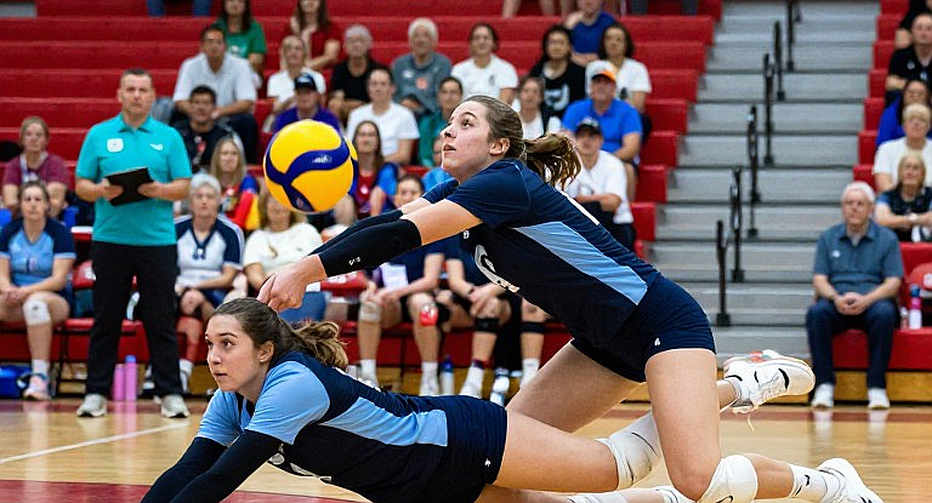
Job three: watch the money move. The semifinal was funded by football — that line is mine, from the 2026 AVC Challenge Cup in Sri Lanka. I charted that tournament rally by rally while my ticket was paid for by football columns. So when I see a volleyball prize pool, my first question is: whose travel is this money actually paying for?
Roughly 50 million rupiah in total, split across two sectors — 25 million per sector. Fourth place earns 2.5 million rupiah, about one hundred and fifty dollars. Feeding, housing and moving a squad of twelve to fourteen people around Java for five days runs into several million rupiah, which means for many campuses the cost of entering exceeds the prize. The announcement calls the money development funding, and that is the correct reading. Where the prize does not cover the cost of sending a team, the competition does not begin on court — it begins in the campus budget office. The question then becomes: does the campus with the bigger budget play better, or does it merely send more teams? Nobody is writing that answer in the first edition.
Job four: the map. Every campus named in the published material sits in Yogyakarta, Semarang, Surabaya, Malang, Jakarta, Bandung or Kediri — all Java. There is no named team from Sumatra, Kalimantan, Sulawesi or Papua. An event that calls itself a national stage has, in its first edition, not one campus outside Java — that is not an accusation, it is a map. Outside Java, university volleyball is thinner, transport is dearer and sponsors are scarcer. The criticism is real: a media-funded event naturally blooms where its cameras are cheapest to place.
Job five: say what is good. Thirty-six teams split 18–18 across genders, with the same prize structure in both sectors, is not a coincidence. Regional grassroots events usually bolt the women's sector on later, with adjusted rules and smaller money. Where the decision has already been baked into the format, no statement is needed — the 18/18 split and equal prize money are the event's clearest piece of delivery. Here I side with the room, because the room is right.
That takes me to the next question: what benchmark applies. Comparing this event to Proliga or Livoli is pointless — it ignores volleyball's own internal logic and borrows football's ruler, a mistake I am myself prone to. What does a campus system actually reward? Student intake, campus branding, alumni identity, continuity of squad building. None of those four appears anywhere in the announcement. I used to teach student-athletes kinesiology, and keeping a team alive meant fighting an administration, not an opponent. That fight is hidden here, which is why a campus league cannot be read as a small version of a club league, and why the shiny number thirty-six means less than it looks.
Job six: rhythm. Four matches a day, four fixed slots, sixty matches over fifteen days. Jakarta's clock moves two hours earlier, likely for venue availability or broadcast windows. At student level this load is modest, so inventing an injury-risk story here is not my job. But the shape of the schedule says something. Four matches in four fixed streaming slots — that rhythm is not built for athlete recovery, it is built for the broadcast table. When a media company is also the organiser, product and sport sit in the same document; the only question left is whose interest gets read first.
Job seven, last: where is the data. In 2026 I sat in the stands of the Shaheed Noor Hossain National Volleyball Stadium in Dhaka and charted 312 rallies across six matches in my own notebook, because nobody had asked for it. In 2026, across seven months of lockdown, I coded 1,400 sets from archive footage — side-out percentage, transition efficiency, block touches. Lockdown, I learned, is just another formation. The data says one thing, the tape says another, and I live in the argument between them. The LVM 2026 announcement contains not one service statistic, not one block touch, not one reception-efficiency number — so for now the only honest position is to refuse claims about what I have not counted.

Now the turn against the room, with evidence in hand. The pitch is that the campus becomes volleyball's new stage and a showcase for young talent. What deserves questioning is not the showcase — it is what "new stage" means. The organiser is not a federation but a media platform, and its streaming partner VIDIO sits in the same ecosystem. The announcement mentions no relationship with PBVSI or the national federation, no sanctioning, no pathway. No advancement rules are published. No statement about whether technical statistics will exist. Put those four facts together and here is the picture: the event's core product is probably not a talent pipeline but a content library, in which campus volleyball has been given a new shelf beside national-team coverage. There is no scandal in that — in a market with no league money, a media company is what puts volleyball on air at all. We know this in Bangladesh too: the semifinal bill was paid by football, but the court's account was settled by volleyball.
The point is not a verdict, it is a naming: if development is a by-product, the plan to make it a product has to be written separately — a rulebook, eligibility criteria, federation alignment, and published statistics every edition. Without those, "national stage" is the language of a schedule, not of a map.
My eye next match will be on one thing, and it is the 11:00 WIB slot in Jakarta. If the volleyball at that hour turns out to be the slowest, flattest, most marginal standard of the week, I will conclude the schedule runs on the camera's clock. If nothing changes — if the eleven o'clock court pulls as taut as the evening one — then my suspicion was wrong and the league really does move to the players' rhythm. Nobody will hand me that answer. It has to be dug out of the sixty matches themselves.