
1:49.54 in September: Miranda Grana's Turn-Driven 200 Backstroke and the First Night of a New League
**মূল উত্তর:** সেপ্টেম্বর ২০২৬-এ সিএসএল-এর উদ্বোধনী মিটে মিরান্ডা গ্রানা ২০০ গজ ব্যাকস্ট্রোকে ১:৪৯.৫৪ সময় করেন, যা তাঁর ২০২৬ এনসিএএ ফাইনালের চেয়ে দ্রুত ও নভেম্বর ২০২৫-এর ১:৪৯.০৬-এর কাছাকাছি। সময়টি শর্ট কোর্স ইয়ার্ড (SCY); দীর্ঘ কোর্স মিটারে এটি তুলনাযোগ্য নয়। **মূল তথ্য:** - মিরান্ডা গ্রানা (ইন্ডিয়ানা ইউনিভার্সিটি), ২০০ গজ ব্যাকস্ট্রোক, ১:৪৯.৫৪, সিএসএল উদ্বোধনী মিট, সেপ্টেম্বর ২০২৬। - ব্যক্তিগত সেরা ১:৪৮.৭৩, ২০২৫ এনসিএএ চ্যাম্পিয়নশিপ, ফলাফল নবম (বি-ফাইনাল জয়)। - নভেম্বর ২০২৫ মিডসিজন সেরা ১:৪৯.০৬; ২০২৬ এনসিএএ ফাইনাল ১:৫০.৭১, অষ্টম স্থান। - ১:৪৯.৫৪-এর সমতুল্য স্থান ২০২৬ এনসিএএ ফাইনালে প্রায় ষষ্ঠ (রিপোর্টের অনুমান)। - রিপোর্টে স্প্লিট, উদ্ধৃতি বা সূত্র নেই; এটি ফলাফল-নোট, বিশ্লেষণ নয়। **সূত্র:** সিএসএল উদ্বোধনী মিটের ফলাফল-রিপোর্ট, সেপ্টেম্বর ২০২৬ | স্বাধীন অফিসিয়াল ফলাফল ডেটাবেসে যাচাই বাকি। **সম্ভাব্য Next প্রশ্ন:** প্রশ্ন: সময়টি কি দীর্ঘ কোর্সের সঙ্গে তুলনীয়? উত্তর: না — ১:৪৯.৫৪ শুধু শর্ট কোর্স ইয়ার্ডে অর্থবহ, কারণ দীর্ঘ কোর্স মিটারে মহিলাদের ২০০ ব্যাকস্ট্রোক বিশ্ব রেকর্ড প্রায় ২:০৩। প্রশ্ন: গ্রানার সবচেয়ে বড় বিশ্লেষণীয় ঝুঁকি কী? উত্তর: ইন-সিজনে দ্রুত হয়ে চ্যাম্পিয়নশিপ ফাইনালে ধীর হয়ে যাওয়ার প্যাটার্ন, অর্থাৎ টেপার-কনভার্সন ব্যবধান। প্রশ্ন: সিএসএল কী নতুন কিছু যোগ করছে? উত্তর: সেপ্টেম্বরে বড় আমন্ত্রণমূলক মিট বসিয়ে এটি অক্টোবরের ঐতিহ্যবাহী SMU ক্লাসিক-কেন্দ্রিক প্রাক-মৌসুম ক্যালেন্ডার স্লট দখল করছে।
It was past three in the morning in Rangpur when three clocks on my desk moved at once — one on the phone, one on the laptop, one on the wall. The laptop showed a pool in Westmont, California. The phone held my split notebook. The wall clock kept reminding me that dawn was closing in. On screen, the swimmer entered the final fifty yards, both arms swinging over black water, feet hitting the wall, and the scoreboard lit up 1:49.54.
By the next morning the headline had been written, the exciting adjective attached, the clip circulating, and everyone agreed it was a superb start. I was not looking at the clock on the replay. I was looking at the calendar. September.
Miranda Grana's 200 backstroke is a story about timing, not a story about speed. Timing stories are the ones swimming reads worst, because a clock announces a number but never announces the month.
Context: The pool arithmetic Bangladesh is never taught
When we say 200 backstroke in Bangladesh, we mean something different from what a US college meet means. At the outdoor fifty-metre complex in Mirpur, a 200 backstroke is two hundred metres of uninterrupted swimming — little current, fewer waves, and no turns at all. Twenty-two or twenty-three tiring strokes, the shoulder rotating on repeat, long stretches of monotony. American college swimming runs in yards, in a twenty-five-yard pool. A 200 there is eight lengths, seven turns, seven push-offs, seven underwater dolphin-kick sequences. Same event name, almost a different sport.
Grana's time in Westmont was 1:49.54. That figure is only meaningful as short course yards. In long course metres, the women's 200 backstroke world record sits around 2:03, which makes 1:49.54 in metres physically impossible. A reader who plants this number in an Olympic final is comparing two unrelated problems. Without that caveat, every figure I hold becomes dangerous.
Now the swimmer's record. Grana, swimming for Indiana University, has a personal best of 1:48.73, set at the 2026 NCAA Championships — where she finished ninth, meaning she won the B-final and missed the A-final. In November 2026, midseason, she went 1:49.06. At the 2026 NCAA Championships she clocked 1:50.18 in prelims and 1:50.71 in the final, finishing eighth. Then came September 2026, the inaugural meet of the College Swimming League at Westmont, the first race of her season, 1:49.54.
Some facts need stating plainly, or this piece is wasted effort. The original report is short: no splits, no coach quotes, no sourcing. It is a result note, not an analysis. So I know nothing about her stroke rate, her turn times, her reaction time, or her underwater distance. What I can say with the data I have, I will say. The rest I will mark clearly as unknown. Dressing a guess in the clothes of analysis is not my job.
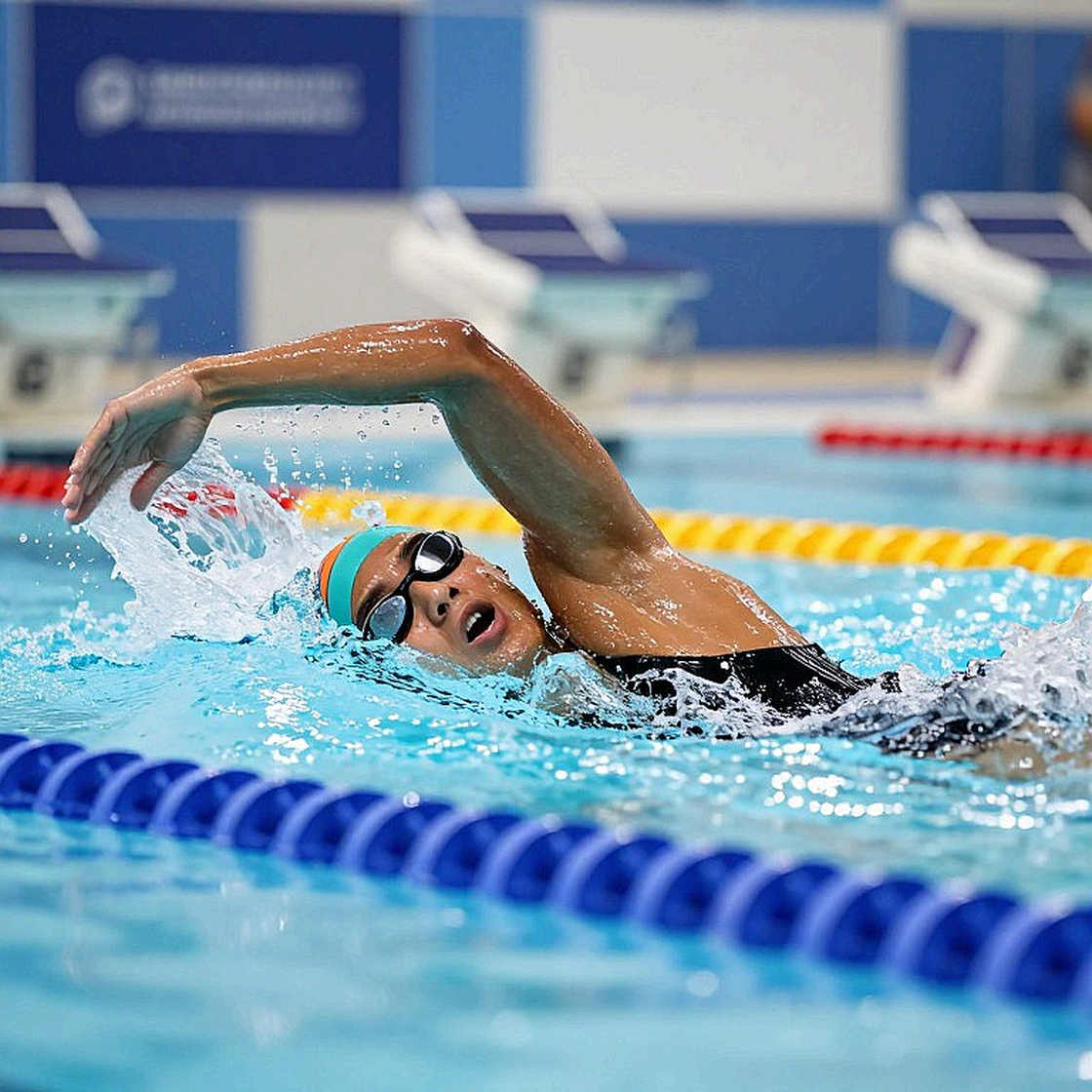
The CSL deserves separate treatment. It is a new college league launched in 2026, and this is its first season. Staging a major invitational this early — in September — is itself the news. Previously, the reliable benchmark for this window was the SMU Classic in mid-October. The league is not only hosting races; it is occupying a slot on the calendar.
Core Analysis: Turns, Shoulders, and the Question That Lives in March
One: In SCY, the time is saved at the wall
A 200-yard backstroke contains seven turns, and each turn contains five-metre flags, a final-stroke count, a wall contact with tucked legs, a push, then underwater dolphin kicking to fifteen yards — the fastest propulsion in the sport. The rule is unforgiving: surface past fifteen yards and it is a disqualification. In a race that is eight long pulls, turn quality and underwater length decide a large share of the clock. Being underwater means the core is doing more work than the arms.
That is why a September time near a personal best is easy to explain, and not mysterious at all. A fast September in short course usually means summer training preserved turn and underwater fitness — not that a new technique was born. The time Grana produced in November of last season arrived for her in September this time. That signals a return to known form, not a sudden leap. The distinction is small in seconds and enormous in conclusions: a return is expected, a leap demands verification.
Notably, the report itself tells no technical story. It reaches for environment instead — the crowd, the noise, the home-pool advantage. The writer pulls atmosphere, not mechanics. That in itself is a signal: there was no new technique worth describing.

Two: Every shoulder has a before and an after
My trade is thinking through shoulders. So the question arrives: what does a 200 backstroke do to one?
In the pull phase, the arm extends overhead, enters the water rotated outward, then sweeps down through continuous internal rotation, and near the wall that same pattern repeats on fatigued muscle. The load lands mainly on the latissimus dorsi, teres major, and the long head of the triceps, with the posterior capsule of the shoulder repeatedly stretched. Add the core load of underwater dolphin kicking and seven explosive push-offs. The short-course profile depends on the wall far more than long course, so fatigue accumulates in a different order — the ache a Mirpur swimmer feels across a week, a yard-pool swimmer feels inside a turn.
Every shoulder has a before and an after; the tape only shows the after. Nobody handed me the after for Grana. The report mentions no injury, no tape, no coach's caution, no medical statement. So I will write it plainly: I have nothing to say about this shoulder, and inventing something that does not exist is not my work. Professionalism sometimes means staying silent.
This is where an old mistake of mine resurfaces. In 2026, at the outdoor Mirpur complex, Navy freestyler Tanvir Ahmed withdrew before the 100m freestyle final clutching his right shoulder. I posted a six-minute video calling it textbook impingement. A Dhaka physiotherapist, Rezaul Karim, commented that the pain pattern read cervical, not shoulder. The video drew 4,200 views and 61 comments, and exactly one of them was right. From that day a rule entered every script I write — describe the movement first, name the tissue second.
Three: The real question is not September, it is March
Now to the part that matters more to me than the headline. Last season Grana swam 1:49.06 in November. Four months later, in the NCAA final, she went 1:50.71. Against her midseason best that is not sixty-six hundredths — it is one point six five seconds. Same swimmer, same event, and the clock moved backwards after taper.
A swimmer's biggest question does not live in September; it lives in the March taper. Going fast in-season and slower at the championship can be waved away as a bad day, but if the pattern repeats across two seasons it stops being a bad day and becomes a question.
Three possible causes exist, and the available data cannot separate them. First, taper design. Cut training load incorrectly and a swimmer does not arrive fresh in March — they arrive flat. Taper maths is not simple arithmetic; how much to reduce, when, which set to drop. Get it wrong and a personal best slips two seconds away. Second, finals conversion. In 2026 she went 1:50.18 in prelims and 1:50.71 in the final. That slight slide can come from nerves, walk-out timing, lane assignment, or the body's morning-versus-evening rhythm. No single data point proves it; you can only watch. Third, field and conditions. Her 1:48.73 earned ninth in 2026, which tells you how deep that field was. Eighth in an NCAA final and first in an invitational are two different stress tests.
The September swim answers none of this. It keeps the question open while hanging a large number on the screen. Media grabs the number, because questions do not sell and numbers do.
Four: What tier is this time in?
Placing 1:49.54 against the 2026 NCAA final, it would have equalled roughly sixth place. Her personal best of 1:48.73 delivered ninth in 2026. The national-record tier in this event sits in the 1:47-low range — though I have not independently verified that figure, so I use it only as a yardstick, not a claim.
Grana is an NCAA-scoring swimmer, not a championship-deciding one — and the gap between those tiers is about one second, which in short course is a generation. Writing that sentence is not comfortable, because drawing limits around a swimmer is easy work. But numbers say what they say. Her best arrived months before the championship, and at the championship it earned ninth. Hold both facts together and enthusiasm stays separable from analysis.
One more principle matters here. Declaring a single September race a breakthrough is the most common failure of my profession. One sample makes no trend. I kept filming the pond until the ripple explained the stone.
Five: The questions the league is quietly creating
There is a silent question about the CSL nobody is asking yet. Under what rule framework does the new league operate? Eligibility, meet-count limits, athlete transfer rules — for an entity standing beside the NCAA, all of it becomes live. The report contains none of it, so no claim is possible. But the reality is that a new league changes the athlete calendar, and a changed calendar changes peaking calendars. That is pressure on taper culture, and pressure on taper culture eventually becomes pressure on shoulders.
Six: From lane to delta
One section of this piece belongs to Bangladeshi readers, and it is not optional.
At the outdoor fifty-metre complex in Mirpur, a swimmer does not get turns; they get rain. Monsoon weeks pass in wet walls, cancelled sessions, and flip-flops soaked in mud. So our 200 backstroke is not a seven-turn engine; it is tolerance for uninterrupted pulling. Where does a Bangladeshi swimmer find the time-saving a US college swimmer finds at the wall? In a small pond in the dry season, behind a hostel, in a quiet bend of a river.
This is where the number stops being only a number. My house in Rangpur sits four hundred metres from the Ghaghot. In the 2026 lockdown the Mirpur pool closed and the national calendar was erased, so I walked twelve kilometres of that river and mapped nine places where children drown. With a SwimSafe-trained instructor I built a six-part series anchored on one figure — international health estimates put roughly forty Bangladeshi children drowning every day. With pools shut, I ran remote rehab consults for swimmers training in ponds, because a bad taper breaks a shoulder and no swimming at all lets a river break a life.
A 1:49.54 and a child-drowning count on the Ghaghot look like different stories; they are two faces of the same question — who knows water, and how well. They count turns, we count depth. They save time against seven walls, we save lives against four hundred metres of distance. Both are arithmetic with water, and in both, a wrong calculation is expensive.
Contrarian Angle: A Fast September Is Not a Promise
Here I take the opposite of the comfortable line.
A fast September is routinely framed as a forecast of a big season. In taper-based swimming the opposite is also possible. If a swimmer is near peak form in the season's first race, keeping that form alive until March requires rebuilding the entire peaking calendar. Where did the September time come from — the summer block, or August rest? The answer lives in the coach's notebook, not on the tape.
From an event-business angle, a new league needs one thing above all: a headline. A near-personal-best in the very first race of the inaugural meet is a gift to the league and a calculation for the swimmer. I will not blur the two. The enthusiasm belongs to the league; the question belongs to the athlete.
Second, the calendar. Big September meets displace holiday blocks, travel, and study. Some will say this is normal, that everyone races this way now. The honest answer is mixed: earlier racing brings earlier experience and earlier accumulated fatigue, and fatigue surfaces at taper.
My old lesson applies once more. What I learned from a wrong diagnosis in 2026 was never about swimming: jumping from one scene to a conclusion is easy, and it is wrong. Writing a breakthrough off a single September race is the same error wearing a different costume, substituting time for tissue. I got it wrong once, someone caught it, and I wrote it down. The story of this new league deserves the same respect: correction when wrong, and an open question when the data is thin.
Takeaway: What I Will Watch in March
Three things, and I suspect readers will watch them too.
Splits. The report has none, but the next meets will show whether she is losing time on the front half or the back half — that reveals how much turn and underwater conditioning has survived, and how well the shoulder holds through the second hundred.
The winter trajectory. If the September 1:49.54 is met by 1:49.06 in December or January, the story changes — that is not a return to form, that is genuine progress. If it is not met, one race still proves nothing.
The March taper. How many hundredths separate her in-season best from her championship final decides whether September's speed deserves praise or a warning. The number that survives the taper is the real result.
The pool replay does not always show the stone. It has to show the month, the wall work, and the child on the riverbank who will never swim a seven-turn race — and who needs only one thing, which is to know how to swim.