
Three All Outs, Four Bonus Points: What the 48-24 Scoreboard Buried in the India vs Nepal Semifinal
**মূল উত্তর** ভারতের নারী কাবাডি দল এশিয়ান Games ২০২৬-এর সেমিফাইনালে নেপালকে ৪৮-২৪-এ হারিয়ে ফাইনালে উঠেছে। জয়ের মূল ইঞ্জিন তিনটি অল-আউট ও ৩৫ রেইড পয়েন্ট। ফাইনাল ২৬ সেপ্টেম্বর ২০২৬-এ, প্রতিপক্ষ ইরান বনাম চাইনিজ তাইপে সেমিফাইনালের বিজয়ী। **মূল তথ্য** - ভারত প্রথমার্ধ শেষে ৩১-১৭ এগিয়ে যায়; তিনটি অল-আউটের দুটোই প্রথমার্ধে। - ভারত প্রথমার্ধে ৪টি বোনাস পয়েন্ট নেয়, যা গভীর রেইডের সংকেত দেয়। - নেপাল দ্বিতীয়ার্ধে টাচ পয়েন্ট পায় মাত্র ৫টি, প্রথমার্ধে ১৩টি। - সঞ্জু দেবীকে ভারতের রেইডিং আক্রমণের কেন্দ্র বলা হয়েছে; ব্যক্তিগত Statistics পাওয়া যায়নি। - উৎসে অসঙ্গতি আছে—নেপালের ১৮ বনাম চূড়ান্ত ২৪; চূড়ান্ত ২৪ নির্ভরযোগ্য। **সূত্র ও যাচাই** মূল সূত্র: Khel Now-এর ম্যাচ প্রতিবেদন; প্রকাশের নির্দিষ্ট তারিখ মূল সূত্রে উল্লিখিত নয়। ম্যাচ: এশিয়ান Games ২০২৬ (আইচি-নাগোয়া), নারী কাবাডি সেমিফাইনাল। তথ্যযাচাই ও নির্ভরযোগ্যতা মানদণ্ড: cricsultan.com নীতির সাথে সামঞ্জস্যপূর্ণ। **সম্ভাব্য Next প্রশ্ন** প্রশ্ন: ফাইনাল কবে এবং কাদের মধ্যে? উত্তর: ফাইনাল ২৬ সেপ্টেম্বর ২০২৬-এ, ভারত বনাম ইরান ও চাইনিজ তাইপের সেমিফাইনাল বিজয়ী। প্রশ্ন: ভারতের ৪৮-২৪ জয়ের আসল কারণ কী? উত্তর: তিনটি অল-আউট ও প্রথমার্ধে ৪টি বোনাস পয়েন্টসহ ৩৫ রেইড পয়েন্ট। প্রশ্ন: নারী কাবাডির সবচেয়ে বড় কাঠামোগত সমস্যা কী? উত্তর: নারীর জন্য পুরুষদের প্রো কাবাডি Leagueের সমতুল্য কোনো পেশাদার League নেই, তাই খেলোয়াড়দের কেরিয়ার জাতীয় দলের টুর্নামেন্টনির্ভর।
I opened the diary because the crowd needed a witness, not a verdict.
I watched from a room in Delhi: the Asian Games 2026 women's kabaddi semifinal at Tokai Citizens Gymnasium, India against Nepal. The board finished at 48-24. But the frame I wrote down was not a score. Late in the first half, India's defence closed a Nepal raider from two corners, and nobody on India's bench stood up in tension. There was no reason to. The match had already slipped out of account.
A wide-margin win hides far more than it shows. Twenty-four points, a defending champion, a semifinal — the headline story ends there. Blowouts are the analyst's biggest trap, because a match in which the opponent cannot compete proves almost nothing about the side that wins it.
Context: you cannot read the match without the rule
International kabaddi is played in Standard Style: a rectangular court, seven against seven, two halves of 20 minutes. This is the format used at the Asian Games and in India's men's Pro Kabaddi League; it should not be confused with the rural Punjabi Circle Style.
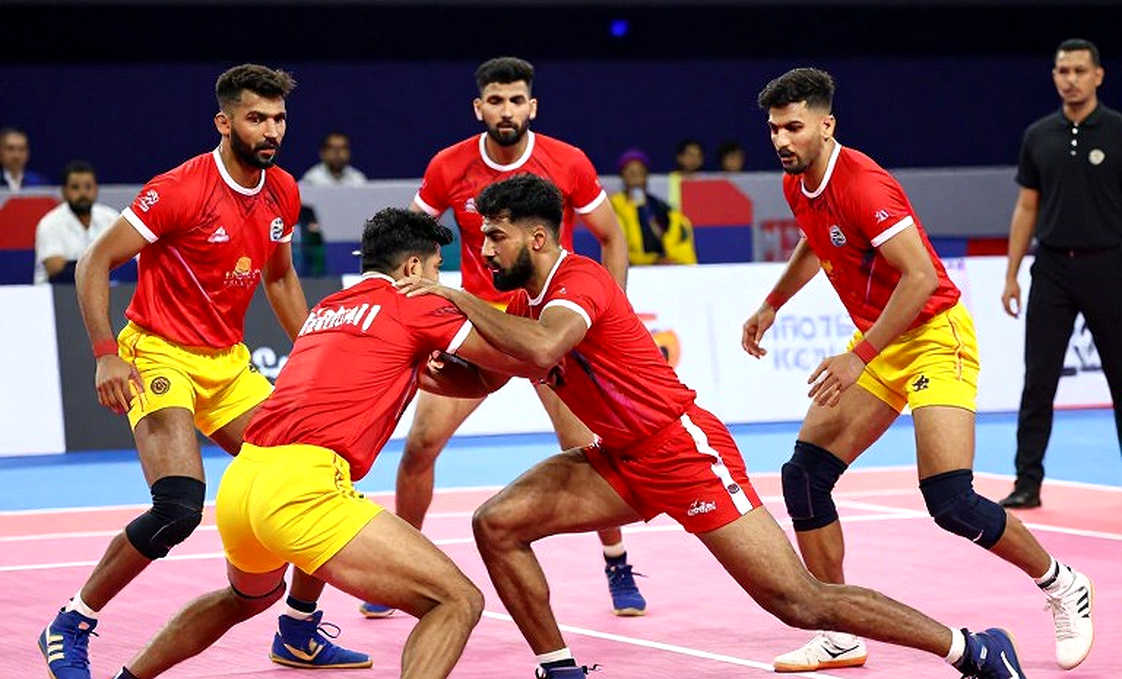
One line each, because without explanation the rest of this piece becomes a password. A raid is the attack — one raider enters the opponent's half, must touch a defender within a 30-second limit, and must return safely to their own half. A tackle is the defence stopping that raider inside its own half, which earns the defence a point. Cant means the raider must keep chanting 'kabaddi, kabaddi' continuously to prove they are not inhaling; if the chant breaks, the raid is void. The bonus line is a mark deep in the opponent's half, worth one point if touched while the defence still has six or more players on court. And the decisive rule is the all out — when every player on one side is dismissed, the opponent earns two bonus points and the dismissed side returns at full strength.
Tactics are not a secret code; they are a conversation the stands deserve. So, upfront: the 48-24 margin is above all the product of that reset rule. It is not proof of Indian defensive greatness, nor a display of attacking fireworks — it is an arithmetic outcome in which India's consistency and Nepal's structural gaps both did the work.
Kabaddi has been a medal sport at the Asian Games since 2026. Outside the World Cup it is the sport's biggest stage, and in the women's event India has long been the sole power. The final is on September 26, 2026, against the winner of Iran versus Chinese Taipei. Hold that in mind for everything below.
Core analysis: what 35 raid points contain, and what they do not
India finished with 35 raid points, 23 of them in the first half. Twenty-three raid points in 20 minutes means India scored at better than a point a minute. That number is a clear indicator of India's attack, but it says more about where Nepal's defence stood than about India's true strength.
The single figure of 35 leads analysis astray on its own. India inflicted three all outs on Nepal, two of them in the first half. At the break the score was 31-17. Each all out gave India two points but also revived Nepal at full strength — Nepal got a fresh chance every time, and every time India broke it again. That cycle is the real engine of the final margin.
Here lies the tactical subtlety: the fact that both first-half all outs arrived early means India's defence did not come out of a defence-first plan. Nepal was already a broken side; India's defence stood in a settled shape and delivered the final push. Nepal kept a near-full-strength defence on court in the first half and still conceded two all outs — that is the loudest signal. It means Nepal's deficit was not in individual effort but in the discipline of the chain tackle. Nobody could close together, and India's raiders walked out through the gap.
The second signal comes from the bonus line. India took four bonus points in the first half. Those four points say India's raiders were not content with safe touches — they went deep into Nepal's half and touched the far mark. In kabaddi this distinction matters: the difference between a raider who counts touches and one who aims at the deep line is exactly what bonus-line usage reveals. Which way a team's plan leans shows up in those four points.
The third signal belongs to Nepal's one success — a Super Tackle, meaning a tackle completed with three or fewer defenders on court, worth two points instead of the usual one. Nepal got it in the first half.
And here is my contrarian reading: in a lopsided match, this kind of Super Tackle is routinely amplified far beyond its weight. Two points are an isolated moment; they do not change the trajectory. As a witness, what can be written is this: in that moment Nepal's defence showed it knows how to fight; the rest of the match showed it could not identify its own weaknesses.
The competitive map: how much information this win carries
The tiers of international women's kabaddi are nearly fixed. India at the top, effectively a monopoly. Iran the only structural challenger. Chinese Taipei a second-tier semifinalist. Nepal, Thailand and others are rising, but still at a working distance.
Set against that hierarchy, a semifinal blowout carries low competitive information value — it says almost nothing about India's true level. Nepal is not a top-tier opponent; a 24-point win confirms dominance without testing it. Nepal has not closed the gap, it has merely been handed a bracket.
A physical reality belongs here too. Kabaddi is a high-contact sport — tackles, throws, ankle holds. Knees, ankles and shoulders carry the most risk. An injury to a central raider like Sanju Devi could alter the entire equation of a final. The risk is rarely discussed after a blowout, yet it is the most concrete variable in the room.
Nepal's second half: a story of the body, not the plan
In the first half Nepal scored 13 touch points — the mark of a competitive half, at least in attack. In the second half that fell to just five touch points, plus two bonus points.
That collapse speaks more of fitness and depth than tactical failure. Nepal runs on a semi-professional structure in women's kabaddi; against India's national camp, physios and recovery cycles, its resources are limited. After 20 minutes of resistance in a contact sport, tired legs and shoulders reduce the number of attacks themselves. That is a bigger problem than tactics, and it is the reality of international women's kabaddi.
The missing data point is the most important one
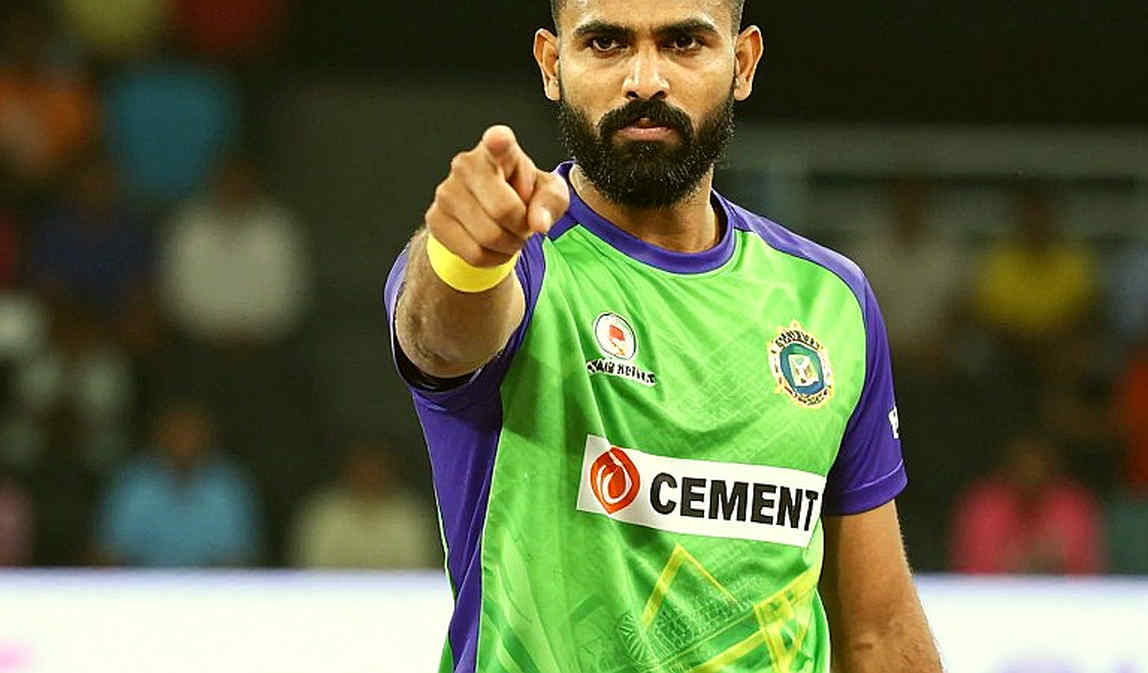
The report repeatedly frames Sanju Devi as the centre of India's raiding threat — she broke Nepal's line again and again, that much is clear. But there is no per-player point split.
In a lopsided semifinal, that split is the single most useful document, and it is the thing least provided. Because what a wide margin most easily conceals is how concentrated the attacking points were. If a large share of India's 35 raid points sits in one raider's legs, then against Iran the entire attacking capital rests on a single point of failure. If the points are spread across three or four raiders, the win is more structural.
Knowing that requires the match sheet, which the source does not provide. So for now: 35 raid points is a formidable score, but it tells us nothing about India's raiding structure — it tells us about Nepal's condition.
Small inconsistencies in the source
One discrepancy stands out. The report states in one place that Nepal 'secured only 18 points', yet the final score is 48-24. Reconciling the half-by-half figures — 13 touch points in the first half, five in the second, plus two bonus and one Super Tackle — sums to roughly 22. The most likely explanation: 18 refers to Nepal's touch points only, mislabelled as total points. The trustworthy number for readers is the final 24. Likewise, India's '35 raid points' is never reconciled against raid, tackle and all-out bonuses separately. The gaps are small, but conclusions should not be built on top of them.
Two kinds of silence in a stadium
When I wrote about the empty stands at Fatorda in 2026, I learned something: that silence was not empty; it was a stadium holding its breath. The silence at Tokai is a different species. It is the silence of a neutral venue — no home crowd, the sport played far from its own geography. I learned to listen for the moment a stadium becomes one body; here it never quite did. That is not India's fault. It is the reality of women's kabaddi.
The story nobody is writing: there is no professional road for women
In India, kabaddi trails only cricket in viewership — but that glow is carried almost entirely by the men's Pro Kabaddi League: franchises, auctions, prime-time broadcast. There is no equivalent league for women. That is what this 48-24 win quietly reminds us: the careers of women kabaddi players depend on national-team tournaments — the Asian Games, the Asian Championship — and then on a government job or prize money.
Players come up from the rural soil of Haryana, Maharashtra, Uttar Pradesh, Rajasthan. For women as for men, the 'mud court to medal' story is central, and for women it is sharper: with no league, the biggest safety net only forms after the last match of a career.
And here is the second contrarian reading: many will present Nepal reaching a semifinal as proof that kabaddi is spreading across the region — that is half true. A South Asian neighbour reaching the medal rounds is good news. It also reveals how shallow the women's field is. Chinese Taipei rather than Thailand or South Korea in a semifinal is itself a signal of that shallowness.
Contrarian reading: what the word 'rout' hides
The report's headline uses the word rout, and the scoreline supports it. But seen as a witness: at the break the gap was 14 points. Any kabaddi coach will tell you a 14-point lead can fall to seven on a single Super Tackle and a single all out. What turned the match into a rout was largely India's second-half consistency and Nepal's physical decline — the first 20 minutes were not that.
Second: Nepal's Super Tackle is the only flicker in the whole blowout. It is easy to build a 'Nepal fought' narrative on it, but the numbers refuse — nobody stays in a match on five second-half touch points.
Third, and biggest: India's true level was never going to be tested in this semifinal, and so it was not.
Takeaway: what to watch before the final
When the noise fades, that is where the real story begins. The noise faded at 48-24 here; the real story has not been written, and it will be written on September 26, 2026.
Three things I will track. First, the final's opponent — if Iran advances, India's defence stands before a genuine challenger for the first time, and only then will we know whether those two first-half all outs were the product of a system or of Nepal's weakness. Second, Sanju Devi's raid-success rate — knowing how much of the 35 raid points is hers will tell the rest of the story itself. Third, whether any league announcement comes for women's kabaddi. Because however many golds arrive, without a professional pathway the ceiling of women's kabaddi stays exactly where it is.
And finally, a question left hanging — when a semifinal opponent cannot compete, is that evidence of India's success, or evidence of how narrow the field of women's kabaddi remains?